 Lucky Lady Club
The Ultimate Guide to CS:GO Cases: Mechanics, Odds, and the Economy
Few phenomena in gaming have influenced internet culture, economics, and first-person shooter design quite as much as the CS:GO case. Even though Counter-Strike 2 (CS2) has since succeeded Counter-Strike: Global Offensive, the legacy of cases, keys, and skin trading remains a foundational pillar of the game’s ecosystem.
For the uninitiated, opening cases can seem straightforward: pay a few dollars, get a virtual weapon finish, and jump into a match. However, beneath the surface lies a complex virtual economy, strict mathematical probabilities, and a massive community trading market. This guide explores the mechanics of CS:GO cases, the odds of hitting the jackpot, and how the virtual marketplace operates.
What is a CS:GO Case?
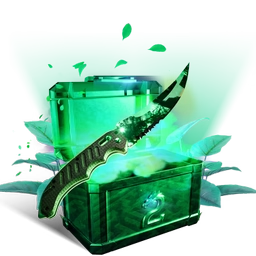
A CS:GO case is a virtual container holding various weapon finishes (skins), knives, and gloves. Introduced during the “Arms Deal” update in August 2013, cases quickly transformed Counter-Strike from a tactical shooter into a virtual trading card game of sorts.
To open a case, players need two things:
- The Case: Earned as random drops after completing matches on official or community servers, or purchased directly from the Steam Community Market.
- A Key: Purchased exclusively in-game for £2.50 GBP (or regional equivalent).
Once opened, the player receives one random item from the case’s predefined drop list. The item is then added directly to the player’s Steam Inventory, where it can be kept, equipped, traded with other players, or sold on the market.
The Mathematics of Opening Cases: Rarity Tiers and Odds
One of the most frequently asked questions surrounding CS:GO cases is: What are the actual odds of winning?
Valve Corporation, the game’s developer, eventually published official drop rates for Chinese region compliance, confirming what statisticians had estimated for years. The odds are stacked heavily in favor of lower-tier items.
CS:GO Case Rarity Breakdown
| Rarity Level | Item Type | Approximate Drop Rate |
|---|---|---|
| Blue | Mil-Spec (Base Grade) | ~79.92% |
| Purple | Restricted | ~15.98% |
| Pink | Classified | ~3.20% |
| Red | Covert (Top Tier) | ~0.64% |
| Gold | Special Item (Knife / Gloves) | ~0.26% |
Beyond these base tier probabilities, items also feature Float Values (wear ratings ranging from Factory New to Battle-Scarred) and a chance to be StatTrak™ (a feature that tracks kills with that specific weapon). The odds of rolling a StatTrak™ variant are roughly 10% of the normal drop rate for that tier.
The Economics of Skins: Why Do They Cost So Much?
The value of a CS:GO skin is entirely driven by supply and demand, governed by the principles of a free-market economy. Certain rare items have famously sold for hundreds of thousands of dollars.
Several factors dictate the price of a skin:
- Rarity: Covert weapons and Special Items (knives/gloves) are exceptionally rare to pull from a case.
- Wear Condition: Some skins look better when heavily worn (Battle-Scarred), while others look terrible unless they are Factory New. Conversely, extremely rare high-float “Vanilla” or “Black Pearl” finishes can command massive premiums.
- Float Value: Exact wear values matter to collectors. A skin with a float of 0.0699 might be worth drastically more or less than one with 0.0001.
- Discontinuation: When Valve moves a case to the “Rare Drop Pool” (meaning it rarely drops after matches anymore), the supply of that case dwindles, causing the price of both the case and its contents to rise over time.
Types of Cases in Counter-Strike History
Over the decade-long lifespan of CS:GO, Valve released dozens of cases, each tied to major updates, operations, or esports tournaments.
- Weapon Cases (e.g., CS:GO Weapon Case I, II, III): The OGs of the skin economy. Cases like the original Weapon Case now command thousands of dollars simply for the historical value of the cases themselves.
- Operation Cases (e.g., Breakout, Vanguard, Riptide): Released during limited-time operations. These often introduced iconic knife finishes like the Butterfly Knife or Skeleton Knife.
- Community Cases (e.g., Dreams & Nightmares, Gallery): Curated collections featuring artwork submitted by community workshop creators, who receive a cut of the key sales.
Tips for Navigating the CS:GO/CS2 Economy
Whether you are a casual player looking to spruce up your inventory or a budding trader, keep these best practices in mind:
- Treat it as entertainment, not investment: Statistically, opening cases is a net-negative financial endeavor. Always set a strict budget.
- Buy singles when possible: If you want a specific skin, buying it directly from the Steam Market or third-party marketplaces is almost always cheaper than trying to unbox it.
- Beware of scams: Never click random links, log into third-party trading sites with your Steam credentials, or accept trades from unfamiliar users promising “overpay.”
Frequently Asked Questions (FAQ)
Can I still open CS:GO cases in Counter-Strike 2?
Yes. All legacy CS:GO cases, keys, and skins carried over seamlessly into Counter-Strike 2. Cases function identically in the updated game engine.
Are CS:GO cases gambling?
Legally and practically, yes. Because you pay real money (via keys) for a randomized chance at a high-value or low-value return, case opening is classified as loot box gambling. Several countries have placed strict regulations or outright bans on loot boxes for this reason.
What is the most expensive skin ever unboxed?
While exact private transactions are hard to verify, public sales of ultra-rare items—such as factory-new StatTrak Karambit Case Hardened (Blue Gem) or certain pristine Souvenir AWP Dragon Lores—have reached values upwards of £100,000 to £500,000 GBP.
Do cases expire?
No, cases do not expire. You can keep them in your inventory indefinitely. In fact, many players treat older cases as long-term investments because their supply decreases as they are opened.
Disclaimer: The virtual economy of Counter-Strike is volatile. Always exercise caution and gamble responsibly.
Find the perfect CS2 skin with insights into each Case Opening, including rarity tiers, weapon finishes, and collection highlights.